Mendocino Outdoors, Fifth Edition
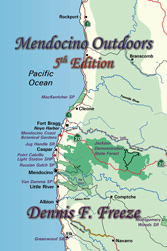 After four editions in print, I've turned my guidebook, Mendocino Outdoors, into an ebook, published in April 2017. You can buy a copy at Smashwords.com, the Apple iBooks Bookstore, Amazon’s Kindle Books, and Barnes & Noble's online store.
The Fifth Edition of Mendocino Outdoors sets a new standard for guides to outdoor activities on the Mendocino Coast. It covers all of the parks and preserves in the area, from the Lost Coast to Gualala, plus some inland jaunts to the wine country and some of the tallest trees in the world. The guide is filled with full-color maps of all the areas described in the book, as well as photographs to show you why you want to visit the various locations.
Fortune Cookies
«Again»
Consider a technique used by the legendary pickpocket Apollo Robbins, another coauthor of the Nature article spearheaded by Macknik and Martinez-Conde. When the researchers asked him about his devious methods--how he could steal the wallet of a man who knew he was going to have his pocket picked--they learned something surprising: Robbins said the trick worked only when he moved his free hand in an arc instead of a straight line. According to the thief, these arcs distract the eyes of his victims for a matter of milliseconds, just enough time for his other hand to pilfer their belongings.
At first, the scientists couldn't explain this phenomenon. Why would arcs keep us from looking at the right place? But then they began to think about saccades, movements of the eye that can precede conscious decisions about where to turn one's gaze. Saccades are among the fastest movements produced by the human body, which is why a pickpocket has to trick them: The eyes are in fact quicker than the hands. "This is an idea scientists had never contemplated before," Macknik says. "It turns out, though, that the pickpocket was onto something." When we see a hand moving in a straight line, we automatically look toward the end point--this is called the pursuit system. A hand moving in a semicircle, however, seems to short-circuit our saccades. The arc doesn't tell our eyes where the hand is going, so we fixate on the hand itself--and fail to notice the other hand reaching into our pocket. "The pickpocket has found a weakness in the way we perceive motion," Macknik says. "Show the eyes an arc and they move differently."
While the magicians are educating the scientists, so far the scientists haven't offered much in return. Cowboy trick aside, Teller says, "this is an example of entertainers getting there first." And he wishes it weren't so. Teller hopes that laboratory insights will offer ways to break free of the stale tricks that have defined magic for decades--much as new technologies made possible the illusions of David Abbott in the early 20th century. A loan shark in Omaha, Nebraska, Abbott performed innovative, late-night shows in his living room. (Harry Houdini was one of many magicians who made the pilgrimage.) "Abbott used to say he wasn't satisfied with a trick unless people began to weep," Teller says. "He was that good."
The Fortune Cookie project is a rewrite of the old Unix file-based fortune cookie program. My version is a WordPress plugin with an Import function and a starting library of a thousand quotes and aphorisms. [More on Fortune Cookies Plugin]


 After four editions in print, I've turned my guidebook, Mendocino Outdoors, into an ebook, published in April 2017. You can buy a copy at Smashwords.com, the Apple iBooks Bookstore, Amazon’s Kindle Books, and Barnes & Noble's online store.